December 4, 2012, in Madiun, Indonesia. A young future domestic helper poses for a video shot by a Hong Kong recruiter seeking new maids to fill the high demands of local employers. The recruiters make them place their hands in this fashion to prove they still have their ten fingers. There is an estimate of 8 million Indonesian migrant workers abroad (including undocumented workers) 75% of them are women. Every month, thousands of women travel to Singapore, Malaysia, Hong Kong, Taiwan, and Saudi Arabia to work as maids. Their primary goal is money. They hope to make a better living and help their families.
December 23, 2012 in Hong Kong. Fatika 22, arrived in Hong Kong a week ago. Two days into her contract she was physically abused by her employer and ran away. Thanks to the help of another Indonesian girl, she went to the police who called an ambulance and did a medical report.
November 29, 2012, in Hong Kong. A young newly arrived helper fills out complaints in the labor department of Hong Kong after being physically abused by her employer, two days into her contract. Regardless of their destination (Asia or Saudi Arabia), Maids are exposed to potential violations of their human rights.
November 26, 2012, in Hong Kong. Window of Kasa Maid Agency in the area of Tsuen Wan. In Hong Kong there are over 1000 employment agencies dedicated to Filipino and Indonesian maids . This building alone countains 31 agencies.
November 26, 2012, in Hong Kong. Ringo Wong is on the phone with a training camp in East Java talking about his future visit to Indonesia. Ringo Wong has been in the employment agency industry since 1994. He manages about 1000 Indonesian maids. He has partnerships with West Java and East Java training camps where he recruits his helpers. Due to Indonesian Government regulations, in order to work abroad one must go through an agency. This is a violation of the 1990 UN Convention that states that direct hiring is a right for all Migrant Workers.
December 4, 2012, in East Java, Indonesia. Ringo Wong sits in the train that links Surabaya to Madiun (East Java, Indonesia). He plans to visit a training camp in Madiun in order to recruit new maids for his agency. Once every two months he goes to Indonesia for such visits.
December 4, 2012, in Madiun, Indonesia. Future maids are being introduced to agency recruiters from Hong Kong. If they are chosen and get a job, they will have to pay the agency a fixed fee of HKD 13,500 (USD 1742). Since they do not have that money upfront, they all sign a loan agreement with a financial institution in Indonesia. The money is then shared by the Training Camp, the Indonesian government, and the agency in Hong Kong.
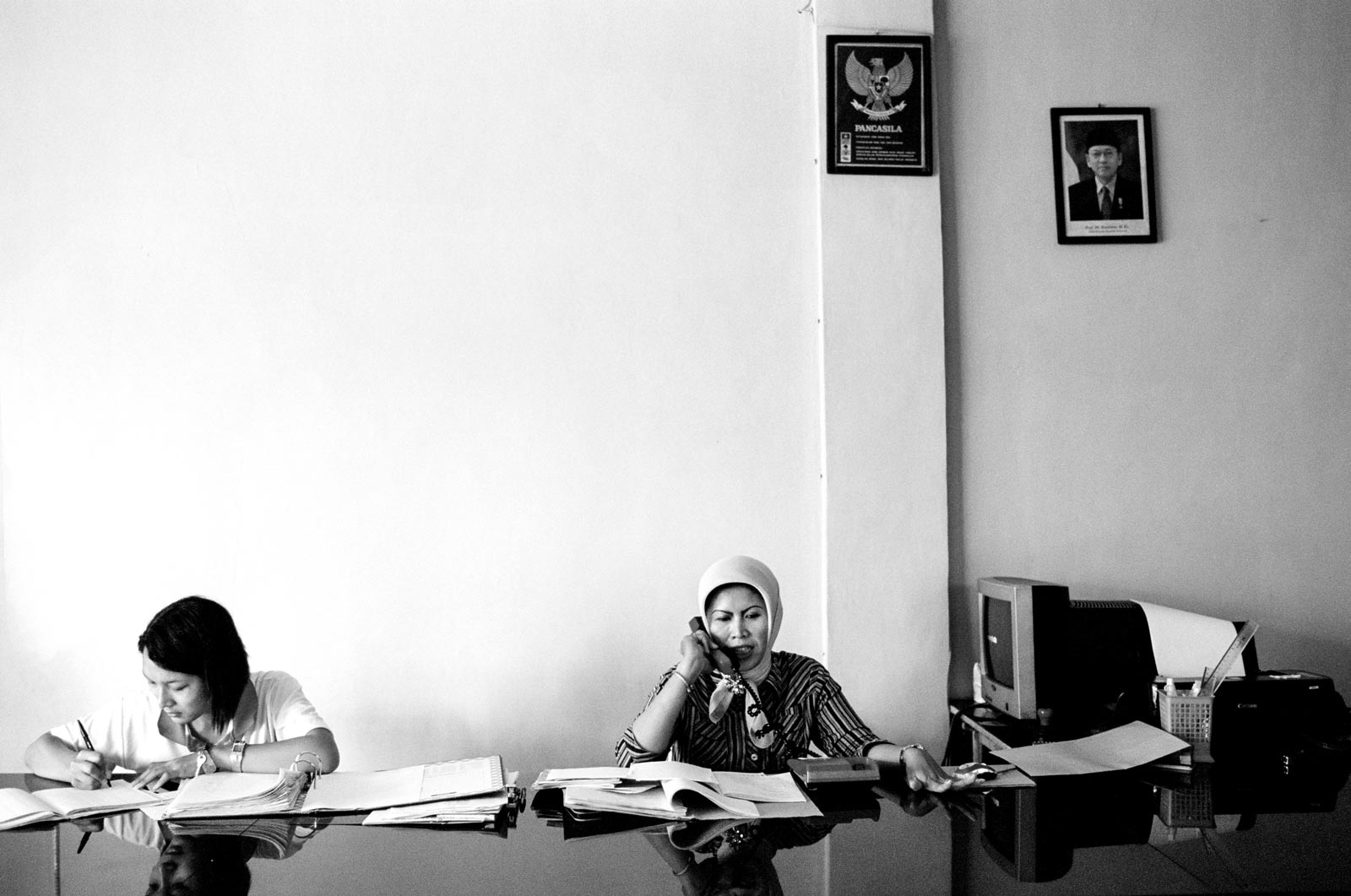
December 4, 2012, in Madiun, Indonesia. Reception desk of the Putra Indo Sejahtera Training Camp. Dozens of new girls hoping to be maids show up at that desk every week.
December 5, 2012, in Madiun, Indonesia. Mr. Pikra and Mr. Nasry are certified recruiters. They earn IDR 7,460,000 (USD 770) for every girl they bring in. In Indonesia, all the potential maids are brought in by recruiters that gained their trust in their village. They bring in an average of 5 girls per month. Since the girl's family has to give their permission, the recruiters pay the families IDR 2,487,000 (USD 260) that the girl will have to reimburse once she starts working. It is known as 'pocket money'.
December 4, 2012, in Madiun, Indonesia. Future helpers from the Putra Indo Sejahtera Training Camp are examined by a government certified teacher before their departure. The government requires a 600 hour training program in foreign langages and household tasks. The future helpers must learn english for Singapore, Cantonese for Hong Kong, and Mandarin for Taiwan. They have about two months to do so. Most of the foreign langage teachers are former maids. Their skills are far from meeting the destination countries' standards.
December 4, 2012, in Madiun, Indonesia. The Putra Indo Sejahtera Training Camp can host 200 girls. There are hundreds of training camps for domestic helpers throughout the country.
December 4, 2012, in Madiun, Indonesia. This woman is in charge of marketing for Hong Kong in the Putra Indo Sejahtera Training Camp. She prepares the information sheets of the students before their interview by Hong Kong reruiters.
December 4, 2012, in Madiun, Indonesia. Winnie Leung , a Chinese recruiter interviews potential maids for Hong Kong. Each maid has a number that is associated to her profile. They are called out by their number and not their name.
December 4, 2012 in Madiun, Indonesia. Ringo Wong shoots the video of a young maid for the potential employers in front of a fake background of a kitchen.The future helper has the opportunity to show her language skill and talk about her overall abilities.
December 4, 2012, in Madiun, Indonesia. Toiletries of the 200 students of the Putra Indo Sejahtera Training Camp.
December 4, 2012, in Madiun, Indonesia. Two students from the Putra Indo Sejahtera Training Camp practice how to use a wheelchair. Many will have to take care of elderlies on a daily basis.
December 4, 2012, in Madiun, Indonesia. Three students from the Putra Indo Sejahtera Training Camp practice baby care in the nursery.
December 5, 2012, in Madiun, Indonesia. Students from the Putra Indo Sejahtera Training Camp learn to use obsolete household appliances. They usually do not meet the Hong Kong standards.
December 4, 2012, in Madiun, Indonesia. Students from the Putra Indo Sejahtera Training Camp rotate by small groups and learn how to perform household tasks such as washing floors and windows.
December 4, 2012, in Madiun, Indonesia. Bathroom and toilets used by the 200 students of the Putra Indo Sejahtera Training Camp. In the past two years, 200 training camps have been closed by the Indonesian government for sanitary reasons. 400 remain.
December 4, 2012, in Madiun, Indonesia. Evelyn Lam Ling, a recruiter from Hong Kong, interviews the girls in small groups. Her goal is to evaluate their language skills in English as well as in Cantonese. Most of these girls have past experience in Malaysia or Singapore. Nevertheless, they have to go through the training since the only way to work abroad is via the agency.
December 4, 2012, in Madiun, Indonesia. One of the most important aspects of the interview is to check the tidiness of the future help. Evelyn Lam Ling checks the hands of a student.
December 4, 2012, in Madiun, Indonesia. Ringo Wong takes a snapshot of a future helper while sweeping the floor. These 'posed pictures' will be used to help future employers pick their maid from a catalogue.
December 5, 2012, in Madiun,Indonesia. At the end of the Hong Kong recruiters' visit, the selected maids from the Putra Indo Sejahtera Training Camp are made to sign a work contract in advance even though the future employer is not yet known. They basically sign a blank contract not knowing the type of work they will do, their salary, and the type of accommodation they will get. This will allow the agency to process the recruitment quickly. Competition is high for agencies in Hong Kong and employers expect to get their domestic helper as quickly as possible.
November 13, 2012, in Hong Kong. Photo of a passport from a young Indonesian. Before their departure, the maids each get their first passport. It is common in the corrupted Indonesian administration that the age of the girl is modified in order to meet with the minimum required age of 23 years old in Hong Kong. This passport is generally illegally held by the agency untill the girl has finished paying her HKD 13,500 fee.
December 5, 2012, in Madiun, Indonesia. Evelyn Lam Ling is giving a last speech to all the 60 girls selected to work in Hong Kong. She reminds them about the basic expectations their employer will have. They must remain tidy, efficient, and forget about their pride.
December 5, 2012, in Madiun, Indonesia. A young Indonesian student from the Putra Indo Sejahtera Training Camp is dreaming of a better future in Hong Kong, Singapore, or Taiwan.
December 12, 2012 in Hong Kong. View of the Wan Chai neighborhood. Hong Kong: 7 millions inhabitants, 300 000 domestic helpers, 150 000 Indonesian maids. The labor cost of migrants is considerably cheaper than hiring locals. On September 2012, the minimum wage for a foreign domestic helper was raised to HKD 3,920. (USD 505)
December 9, 2012, in Hong Kong. Rollick, Indonesian staff of Kasa Maid Agency, has just picked up new helpers from Madiun at the Hong Kong International Airport.
December 9, 2012, in Hong Kong. Wakit is 25 years old. She just arrived form Madiun this morning after more than 12 hours of travel. This is her first day in Hong Kong. She does not yet know for whom she is going to work. She says "I don't know them, but they know me, they chose me out of a video and photos". She speaks english because she has already worked for two years in Singapore but can hardly speak cantonese. She hopes her employer will talk to her in english.
December 9, 2012 in Hong Kong. The girls, upon arrival, are taken to the boarding house of the Kasa Maid Agency. This is one of the requirement made by the Indonesian consulate. An agency must have a suitable boarding house for the first nights of the maids, or in case problems arise with the employer. There are no beds, the girls will have to sleep on the floor.
December 11, 2012, in Hong Kong. Wikit and Winarti arrived two days ago from Madiun. They must wait at the Immigration Center in Hong Kong in order to receive a local ID. Domestic migrant workers have been placed under specific legal rules and policies that are set by the Immigration and Labor Departments regarding conditions of stay, rights of residence, and minimum rate of pay. They must go back home every two years, they cannot drive a car in Hong Kong (since 2003 ), and are not allowed to live outside their employer's house.
December 11, 2012, in Hong Kong. The Indonesian consulate organizes a welcoming package for the newly arrived maids. They are reminded what is expected from them as domestic helpers, with an emphasis on their attitude, as well as their rights. They are entitled to a minimum wage as well as one day off per week. About 1000 indonesian girls arrive every month in Hong Kong. Many agencies do not send the girls to the consulate at their arrival as the priority is to hand the domestic helper to the employer as quickly as possible.
December 11, 2012, in Hong Kong. Wakit is meeting her employer for the first time at Kasa Maid Agency. She finds out here that she will be in fact taken to Mainland China to work for the daughter of this chinese woman. She will have nothing to do except for some general cleaning. No kids or elderlies to take care of. No cooking. No friends.
Hong-Kong: 7 millions inhabitants, 500 000 domestic helpers, 150 000 Indonesian women. The labor cost of migrants is considerably cheaper than hiring locals. On September 2012, the minimum wage is HKD 3,920. (USD 505) December 12th 2012, view from of the Wan Chai neighbourhood, Hong-Kong.
November 20, 2012, in Hong Kong. Lis, 24 years old comes from East Java in Indonesia. She arrived in Hong Kong on January 6, 2012 to work as a domestic helper. In August 2012 her employer falsely accused her of stealing money and clothes. Her employer forced her to sign a paper and shoot a video where Lis acknowledged the theft and then took her to the police. Lis is now in Jail.
November 20, 2012, in Hong Kong. Lis describes a typical day with striking details to bring context to her case.
December 22, 2012 in Hong Kong. Kitchen of Enny's employer.
December 15, 2012 in Hong Kong. Aulia, 32 years old comes from Jakarta in Indonesia. She is has been working for the same family for 6 years in the neigborhoud of Jordan in Hong-Kong. She takes care of two kids : Chloe, 8 years-old and Stuart, 5 years-old.
December 15, 2012 in Hong Kong. This middle classe chinese family lives in a 600 sq feet apartment. Aulia, the domestic helper shares their daily life. Since the husband employer works long hours, Aulia's presence is the only reason the wife can afford to have a job and bring in an additional salary.
December 15, 2012 in Hong Kong. Aulia is cooking diner for the family under the supervision of Selina, her employer.
December 15, 2012 in Hong Kong. Aulia has been taking care of Stuart since he was born. Stuart is now 6 years old and calls her 'Auntie'. Aulia sleeps in the same room as him, on the top bunk.
December 15, 2012 in Hong Kong. Aulia has a popular blog about Domestic Helpers in Hong Kong. She is showing her work to her employer for the first time. Since she works on her blog on her days off, Selina was not aware of her second life. Aulia carries the secret ambition of one day being a journalist. She plans to go back to Indonesia permentantly in March 2013.
December 16, 2012 in Hong Kong. On Sundays thousands of Indonesian girls gather in public parks to take advantage of their only day off. Maids in Hong Kong are all entitled to 1 day off per week. Many employers offer HKD 100 ($12,9) to their maids for them to give up their day off.
December 9, 2012 in Hong Kong. The Kasa Maid agency allows their maids to use their boarding house on Sundays instead of spending the day outside. They can rest, watch TV, and cook Indonesian food. Very few agencies do this.
November 25, 2012, in Hong Kong. View if the Causeway Bay area. On Sundays, their only day off, Indonesian migrants flood the streets of Hong-Kong. Foreign migrant workers have made a major contribution to Hong Kong in terms of its economic growth. Migrants have long performed vital tasks such as providing personalised child and elder-care services to local wage earners. These valuable services have allowed hundreds of thousands of local families the chance to earn two incomes instead of one.
November 18, 2012 in Hong Kong. Many maids spend their Sundays in Fast Food restaurants. Though some stick to the traditional muslim outfit, many radically change their style. Living abroad is also an opportunity for some to publicly expose their sexuality. It is estimated that 20% of Domestic Helpers become homosexual during their time abroad.
November 20, 2012 in Hong Kong. Eni is 27, she comes from Central Java in Indonisia. Her employer has payed only half of her salary over the past 6 months. After many months, she won her case against her employer. She returned to Indonesia on the 26th of December 2012.
November 20, 2012 in Hong Kong. Eni, unlike most abused maids, had meticulously taken notes, recorded, and saved documents, proving her non paiements. She is one of the few to have such a strong case against her female employer.
December 22, 2012 in Hong Kong. Enny, 33, shows me a picture of her 14 year old daughter she sees once a year since she started working 7 years ago. Her husband died many years ago, and her daughter lives with her parents in Indonesia.
December 22, 2012 in Hong Kong. Enny has been working for two years with this elderly family. She speaks perfect Cantonese since she previously worked for 5 years in Hong Kong. She is taking her employers to their favorite Dim Sum restaurant, a daily ritual.
December 22, 2012 in Hong Kong. Every day at 12, Enny gives her elderly female employer a bath. They both sleep in the same room.
December 22, 2012 in Hong Kong. Enny gets her employers ready to go out. A slow routine she carries out every day.
December 22, 2012 in Hong Kong. A family portrait. Working with elderlies can be trying. Enny once told me that she had trouble coping with the terribly slow routine she had to go through daily.
December 19, 2012 in Hong Kong. Yayu 26, from Indonesia, recived chimical products in her eyes when her impatient employer pushed her around while she was washing the windows.
December 19, 2012 in Hong Kong. Yayu is filing a complaint against her employer. She will not be allowed to work for the whole duration of her case.
December 19, 2012 in Hong Kong. Iva 22, comes from East Java in Indonesia. She worked for a Chinese familly with three kids. She worked for three months without receiving any pay. Her Agency tried to convince her not to say anything in order to keep a good relashionship with the employers. She ran away and found refuge at Bethune House. She has been waiting for her case to go to trial for 2 months.
December 16, 2012 in Hong Kong. Several times a year, hundreds of Indonesian Domestic Helpers exercise their right to demonstrate in Hong Kong. The main topics they are fighting against are: Denial of Rights on Direct Hiring by the Indonesian Government, the Prohibition to Change Agencies before the end of a 2 year contract, Dept Bondage, and Poor Auality of Services by the Indonesian Consulate in Hong Kong.
“Dreamseekers”
Every month, tens of thousands of Indonesian women are sent to Asia and Saudi-Arabia to work as domestic helpers.
Young girls dream of better lives and unknowingly become pawns in the modern machine of human trafficking.
Let me tell you the story of a journey followed by so many undereducated Indonesian girls. A journey that starts in a small village in Indonesia, will lead you through training camps in the city, immerse you in a life of servitude, dept bondage, and low pay, far from any known reference, and will end back home, in joy or in tears.
---
After secondary school, these women are often mislead by sponsors who travel across the country selling dreams of adventures overseas, and fantastic monetary prospects. The girls often sign up hoping to find a way to help their families and replicate the success stories they keep hearing about. Local recruiters in Indonesia (called sponsors) have told me that they pay the families to get their permission to bring the girls to Training Camps. This is disguised as an encouragement bonus they call “pocket money”.
The girls are sent to carry out their mandatory training in one of the accredited Training Camps, where they are supposed to learn how to use household appliances, cook, do the laundry, and learn languages. Sadly, most courses are far from adequate leaving them unprepared for the high expectations of their future employers.
Thanks to Ringo Wong, in charge of an agency in Hong Kong, with whom I travelled, I was able to witness the sad machinery of training camps through my lens. What hurts the most is to understand that these camps are built solely to squeeze as much profit as possible out of each girl, with the participation of the Indonesian government.
They leave their homeland with high hopes and aspirations, but more often than not the reality at their destination turns their dreams into nightmares...
Life doesn’t get much better once they are sent off. In some cases, there have been reports and testimonies depicting horrible work environments, exploitation, and rough physical and physiological treatments.
Through my interviews, I keep getting the feeling that these girls are not prepared for this life. They don’t have the tools to know how to react if their employer gets too close, or intrusive. Most girls I have talked to barely know when their rights are violated.
Ironically, the younger inexperienced girls are called "New Borns" by agencies. New Borns get the worst jobs in the worst destinations since they are easier to influence.
Most of these young helpers come from poor villages and belong to the poorest social class in Indonesia. Since they aren’t educated enough to know their rights as workers, it’s easy for sponsors and agencies to take advantage of them.
The standard contract lasts two years in Hong Kong, giving them the possibility to come home to make babies before taking on the next job. They have no choice but to leave their children and husbands behind when they leave.
They may come back to their communities as heroes, but at what price?
I’m illustrating what I consider a modern version of slavery and human trafficking:
My project is on going. My research started in February 2012 and I’ve been documenting for a month and a half in Hong Kong and Indonesia.
I have two more months planned before finishing their story. I will be returning to Indonesia, and spending a few weeks in Malaysia where the standards of living are reputed to be the worst.
I plan on following a sponsor on his tour of Indonesian villages, portraying the families and living situations of future helpers, and illustrating the recruitment process.
The newly recruited helpers will make their bags with the little belonging they have, say good-bye to their families, and take off for a life changing plane ride.
I plan to document their return to Indonesia, and illustrate their experiences. Some manage to start small businesses thanks to their income, while others struggle for the rest of their lives.
----
For a better understanding of the story, please make sure to read the captions.


